Hinglish, Urdish, and code-switching: making mixed-language videos engaging
30 June 2026 · 9 min read · The Clipdify team
Key takeaways
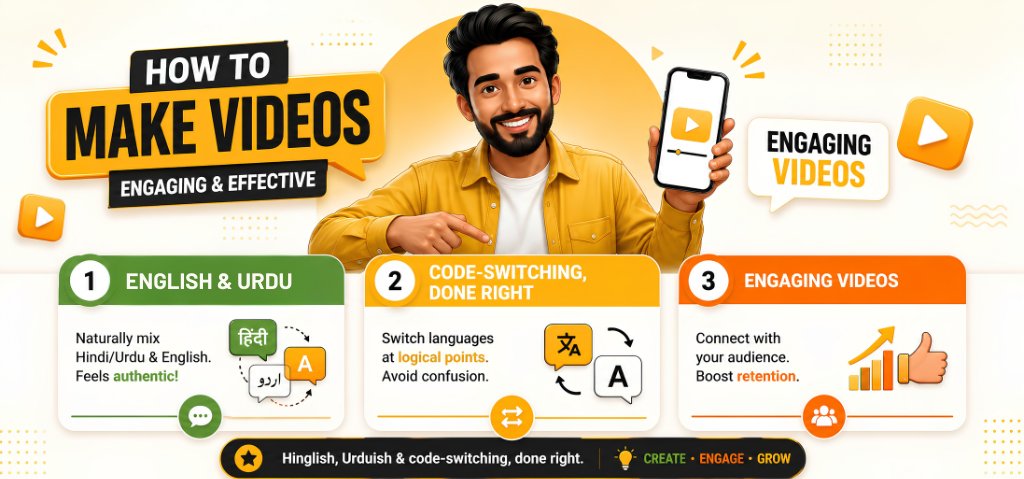
- Caption what was actually said, in the scripts it was said in — mixed captions read fastest for mixed-language audiences.
- Switch scripts at phrase boundaries, keep English tech terms in Latin script, stay consistent per video.
- Use ASR tuned for code-switched speech or you'll spend an hour fixing every transcript.
Nobody in Delhi, Karachi, or Dubai speaks one language at a time. Real speech flows Hindi-into-English-into-Hindi mid-sentence — and captions that fight this (forcing everything into one script) read as fake. The engaging move is to caption what was actually said, the way it was said.
Why code-switched captions outperform
Viewers process their own speech patterns fastest. When your captions switch scripts exactly where the speaker switched languages, reading feels effortless — and effortless reading is retention. When you transliterate everything into Latin script 'to be safe', you add friction for the 80% of your audience who read Devanagari or Nastaliq natively.
The three rules of mixed captions
- 1Switch at logical points: keep whole phrases in one script. Mid-word switches confuse; phrase-level switches feel natural.
- 2Keep English tech terms in English: 'algorithm', 'subscribe', 'thumbnail' — everyone reads these in Latin script. Translating them backfires.
- 3Be consistent within a video: if 'growth' is English in minute one, don't make it हिंदी in minute three.
ASR that hears the switch
The hard part is transcription. English-only ASR mangles the Hindi; Hindi-only ASR mangles the English. You need models tuned for code-switched speech — it's the difference between captions you post and captions you spend an hour fixing. This is precisely the case Clipdify's regional pipeline was built for.
Engage, then measure
Run one video both ways — mixed-script captions vs. all-Latin transliteration — and compare average watch time. Creators who test this rarely go back. Authentic captioning isn't just correct; it's a measurable retention lever.
Why code-switching exists in the first place
Code-switching isn't laziness or 'bad Hindi' — sociolinguists have documented for decades that multilingual speakers switch strategically: English for technical precision, the mother tongue for emotion and emphasis, back to English for brand names and numbers. Your captions should preserve those switches because they carry meaning. When a speaker lands a punchline in Punjabi after three sentences of English setup, flattening the caption into one language literally deletes the joke's timing.
A practical style guide you can steal
- Numbers and units: Latin script, always — '₹50,000' and '10x' read instantly in any language context.
- Proper nouns: whatever script the brand itself uses. YouTube is YouTube, not यूट्यूब.
- Emphasis words: caption them in the script they were *spoken* in, and let the karaoke highlight do the shouting — avoid ALL CAPS in Devanagari or Nastaliq, which reads as broken rendering rather than emphasis.
- Question particles ('na?', 'kya?', 'یعنی؟'): keep them; they're the conversational glue that makes captions sound like the speaker.
Editing code-switched transcripts efficiently
Even with code-switch-tuned ASR, budget a review pass — but make it a targeted one. Errors cluster in three places: proper nouns, the first word after a language switch, and borrowed words that exist in both languages ('order', 'time', 'line'). Scan for those instead of re-reading everything, and you'll fix 90% of the errors in 10% of the time. Fix the transcript once, before clipping — every clip inherits the correction for free.
The authenticity dividend
There's a compounding social effect that analytics only show indirectly: comments. Videos captioned the way people actually speak get comments written the same way, and comment sections that sound like a group chat are magnetic — viewers scroll them, reply, return. That comment culture is a moat no competitor can copy with a font change, and it starts with captions that respect how your audience really talks.
Frequently asked questions
What is code-switching in video captions?
Rendering each phrase in the script of the language actually spoken — Hindi in Devanagari flowing into English in Latin script mid-sentence — instead of forcing everything into one script.
Why not transliterate everything to Latin script?
It adds reading friction for the majority who read Devanagari or Nastaliq natively, and it reads as inauthentic. Effortless reading is retention.
Which words should stay in English?
Universal tech terms — algorithm, subscribe, thumbnail. Everyone reads these in Latin script, and translating them backfires. Just be consistent within a video.