How to go viral with regional captions: think global, speak local
12 July 2026 · 11 min read · The Clipdify team
Key takeaways
- Caption in the language and script your audience reads — it directly lifts 3-second hold, the metric algorithms weigh most.
- English captions on regional audio signal the wrong audience and hurt reach.
- Translate a proven clip's captions and repost it for a neighbouring language market.
The fastest-growing short-form niches of the last two years aren't in English. Hindi tech explainers, Bengali cooking, Tamil cinema commentary, Arabic finance — audiences are enormous, competition is thinner, and platforms are actively pushing regional content to regional feeds.
Captions decide the first three seconds
Most viewers scroll with sound off. If your captions are in a language your viewer doesn't read — or worse, missing — the swipe happens before your hook lands. Creators who caption in the audience's own script consistently see higher 3-second holds, and 3-second hold is the single input the recommendation system weighs most.
English captions on regional audio is a mismatch
A common mistake: recording in Hindi or Arabic but captioning in English 'for reach'. It signals the wrong audience to the algorithm and reads as friction to your actual viewers. Caption in the language you speak; add a translated variant as a second clip if you want to test crossover reach — don't average the two.
Script quality is not optional
- Use fonts designed for the script — Nastaliq for Urdu, proper Bengali conjuncts, Tamil ligatures, RTL-correct Arabic punctuation.
- Keep 2–4 words per caption line for regional scripts; glyphs are denser than Latin.
- Active-word highlighting (karaoke style) works in every script — but the highlight must track the word, not the syllable estimate of an English tokenizer.
The translate-and-repost multiplier
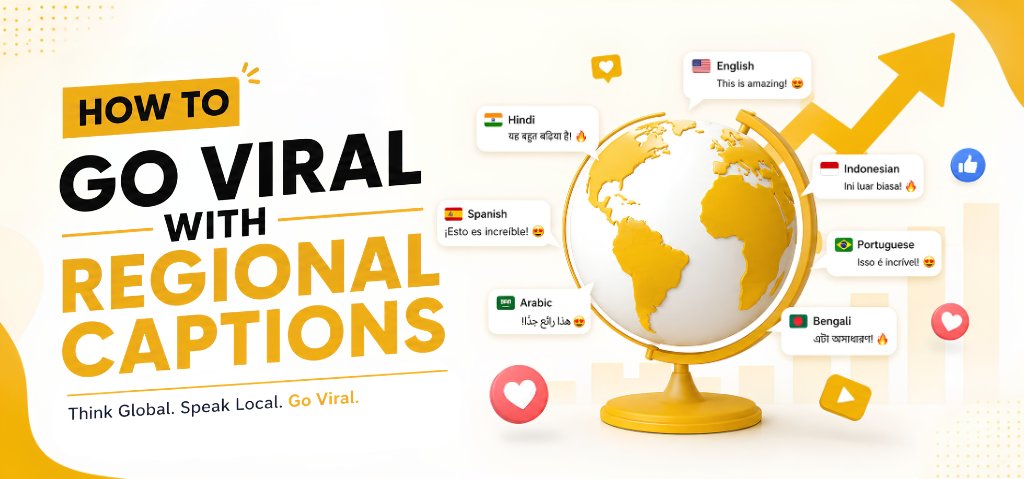
Once a clip proves itself in one language, translate its captions and repost it for the neighbouring audience — Hindi → Urdu, Bengali → Hindi, Arabic → English. Same video, new market, ten minutes of work with automated caption translation. One good moment can legitimately go viral three times.
Think global, speak local isn't a slogan — it's the arbitrage. The tools finally support your script; the audiences were always there.
How the algorithm actually reads your captions
Recommendation systems don't just measure watch time — they read. Platforms run OCR over on-screen text and speech recognition over audio, then use both to classify your content and pick the audience for the first test batch. Captions in clean Hindi, Bengali, or Arabic tell the classifier exactly which regional feed you belong in. Missing or mismatched captions force the system to guess — and a wrong first audience means a bad first test, which suppresses the clip before real viewers ever see it.
A quick test you can run this week
- 1Pick your best-performing clip from the last month.
- 2Re-render it with captions in your audience's native script if it wasn't already, or with noticeably cleaner styling if it was.
- 3Post it at the same time of day, one week after the original.
- 4Compare 3-second hold and average view percentage — not views. Views depend on luck of the test batch; retention numbers isolate the caption effect.
Creators who run this test rarely need convincing afterwards. The retention delta from script-correct captions typically shows up immediately, because it operates on every single viewer in the first three seconds.
Common objections, answered
- 'My niche is English-dominant.' Then caption in English — the principle is audience-script match, not regional-for-its-own-sake. But check your comments: if they're arriving in Hindi, your audience already told you what to do.
- 'Translated captions feel robotic.' Machine translation of captions has a specific failure mode — literal idioms. Fix the three or four idioms per clip by hand; leave the rest. Ten minutes, not an hour.
- 'Non-Latin fonts look bad.' They look bad in tools that fake it with fallback glyphs. Purpose-built script rendering — proper Nastaliq slope, correct conjuncts, RTL punctuation — is precisely what separates professional regional content from the rest.
The bigger picture: regional is the growth market
English short-form is saturated: the formats are mature, CPMs are contested, and every niche has an incumbent. Regional feeds are five years younger. The playbooks that built English channels in 2020 still work in Hindi, Tamil, and Arabic in 2026 — but only for creators whose captions let the algorithm and the audience actually read them. The caption layer isn't a finishing touch; it's the market-entry ticket.
Frequently asked questions
Do regional-language captions really outperform English ones?
Yes — most viewers scroll with sound off, and captions in the viewer's own script consistently produce higher 3-second holds, which is the strongest input into recommendation systems.
Should I caption Hindi audio in English for more reach?
No. It signals the wrong audience to the algorithm and adds friction for your actual viewers. Caption in the spoken language; test a translated variant as a separate clip instead.
What matters most for non-Latin caption quality?
Script-correct fonts (Nastaliq, proper Bengali conjuncts, Tamil ligatures, RTL Arabic punctuation), 2–4 words per line, and karaoke highlighting that tracks real words rather than English-tokenizer estimates.