The Regional Creator's Playbook: from one long-form video to a week of scheduled clips
15 July 2026 · 12 min read · The Clipdify team
Key takeaways
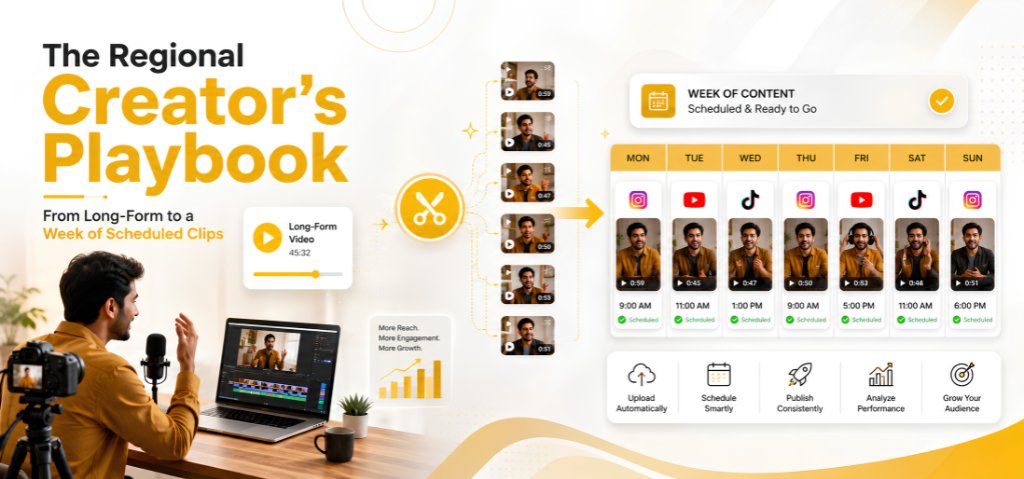
- Every long-form recording should produce at least 7 scheduled short clips before you record anything new.
- Use language-tuned transcription first — moment-scoring only works on a clean transcript.
- Batch-schedule the whole week in one sitting with ~20-minute spacing per account.
Most regional creators don't have a content problem — they have a distribution problem. You already record hours of podcasts, streams, and talking-head videos every month. The creators winning on Shorts, Reels, and TikTok aren't recording more; they're extracting more from what they already record.
The 1-to-7 rule
One 40-minute recording contains, on average, 6–10 usable short-form moments: a strong opinion, a story with a turn, a how-to segment, a reaction, a list. The playbook is simple — every long-form upload must produce at least seven scheduled clips before you record anything new.
Step 1 — Extract the moments
Run the full recording through an auto-clipper that actually understands your language. Generic English-tuned tools miss the hooks in Hindi, Urdu, Bengali, Tamil, or Arabic speech entirely — the moment-scoring falls apart when the transcript is garbage. Clipdify's pipeline transcribes with Indic- and Arabic-tuned ASR first, then scores moments on the clean transcript.
Step 2 — Caption every clip, in the script your audience reads
Retention on silent autoplay is decided by captions. Devanagari, Nastaliq, Bengali, Tamil, and Arabic scripts each have their own rendering pitfalls — clipped ascenders, broken ligatures, wrong-direction punctuation. Use caption styles built for the script, not a Latin font with fallback glyphs.
Step 3 — Schedule the week in one sitting
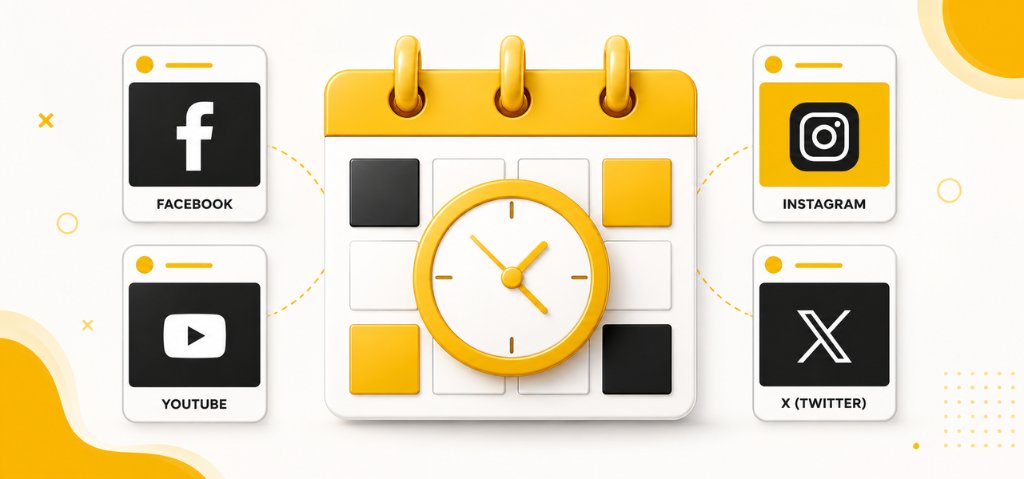
Batch the boring part. Queue all seven clips across platforms in one session with sensible spacing — around 20 minutes between posts per account, capped per rolling 24 hours, so platforms never flag you for burst-posting. Then close the laptop.
The compounding effect
- Week 1: 1 long video → 7 clips → your first data on which moments hold viewers.
- Week 4: you know which hooks work in your language and niche — extraction gets sharper.
- Week 12: a 90-clip back-catalog quietly feeding the algorithm while you only record once a week.
The playbook isn't glamorous. It's a ratio, a caption standard, and a queue. But it's how one-person channels in regional languages out-post studios ten times their size.
What counts as a 'usable moment'
Not every interesting second survives as a standalone clip. A usable moment has a self-contained arc: it opens on a claim or a question, develops it, and lands somewhere — all inside 20 to 60 seconds. When you review auto-clip candidates, judge them against that arc, not against how much you personally like the topic. The clip has to work for a stranger who has never heard of you, mid-scroll, with the sound off.
There's also a category most creators throw away that performs disproportionately well: the tangent. The off-script story, the annoyed aside, the 'this is off topic but…' segment. Tangents are where speakers drop their radio voice and get specific — and specificity is what stops thumbs.
A worked example: one podcast episode, seven clips
- 1Clip 1 — the strongest opinion in the episode, posted first because it will out-perform the rest and warm up the algorithm for your account.
- 2Clip 2 — a how-to segment, captioned step by step. These have a longer shelf life than opinions and keep collecting views for months.
- 3Clip 3 — a story with a turn. Open at the turn, not at 'so this one time'.
- 4Clip 4 — a hot reaction to something current. Post this one early too; it decays fastest.
- 5Clip 5 — a listener-question answer. These convert viewers into followers because they demonstrate you respond.
- 6Clip 6 — the tangent. Trust the tangent.
- 7Clip 7 — a 'best of' micro-compilation of three sub-10-second beats from the episode, which doubles as a trailer for the full upload.
The mistakes that quietly break the system
- Posting all seven clips in one day. The queue exists to spread them; burst-posting wastes five of the seven.
- Re-captioning every clip by hand 'to be safe'. Spot-check the first two; if the ASR is clean there, it's clean everywhere. Trust, then verify weekly.
- Skipping the weakest clip. Post it anyway — your guesses about what performs are wrong often enough that the data is worth more than your taste.
- Changing caption styles every week. Style consistency is how returning viewers recognize you in a feed of strangers.
Scaling past one channel
Once the 1-to-7 loop runs comfortably, the same system scales horizontally. Agencies and clippers run it per client: each client gets a brand kit (fonts, colors, caption style), their own connected accounts, and their own queue. The extraction skill you built on your own content transfers directly — you're just running more queues. This is exactly the workload Clipdify's team workspaces and brand kits were designed around: same playbook, multiplied.
And if you're wondering when to add a second weekly recording: not until the first one reliably fills its seven slots and you have data begging for more volume. The playbook's discipline is doing less recording, better distributed — resist the urge to invert it.
Frequently asked questions
How many clips can one long video produce?
A typical 40-minute recording contains 6–10 usable short-form moments — strong opinions, stories, how-to segments, and reactions. The playbook targets a minimum of 7 scheduled clips per long-form upload.
Why do generic auto-clippers fail on regional languages?
Because their moment-scoring runs on the transcript. English-tuned ASR produces garbage transcripts for Hindi, Urdu, Bengali, Tamil, or Arabic speech, so the scoring misses hooks entirely. Language-tuned transcription must come first.
How far apart should scheduled posts be?
About 20 minutes between posts per account, capped around 25 posts per rolling 24 hours — spacing that avoids platform burst-posting flags.